BIN Profile
Overview and details on BIN profiles within RevCent.
A BIN profile allows you to route payments to specific gateways based on the first 6 (BIN 6) digits of the customers’ card number. BIN profiles only apply to transactions that are run via a Payment Profile. You create a list of BINs using the BIN Table which is a spreadsheet, allowing you to copy and paste from Excel.
Why Use A BIN Profile?
- Increase payment acceptance based on issuing institution BIN.
- Reduce declines when 3DS is not supported by an institution.
- RevCent routes the request when using a Payment Profile
- Create as many BIN Profiles as you want.
View BIN Profiles
View all BIN profiles by clicking the Payments > Credit Card > BIN Profiles link on the sidebar or going to https://revcent.com/user/bin-profiles
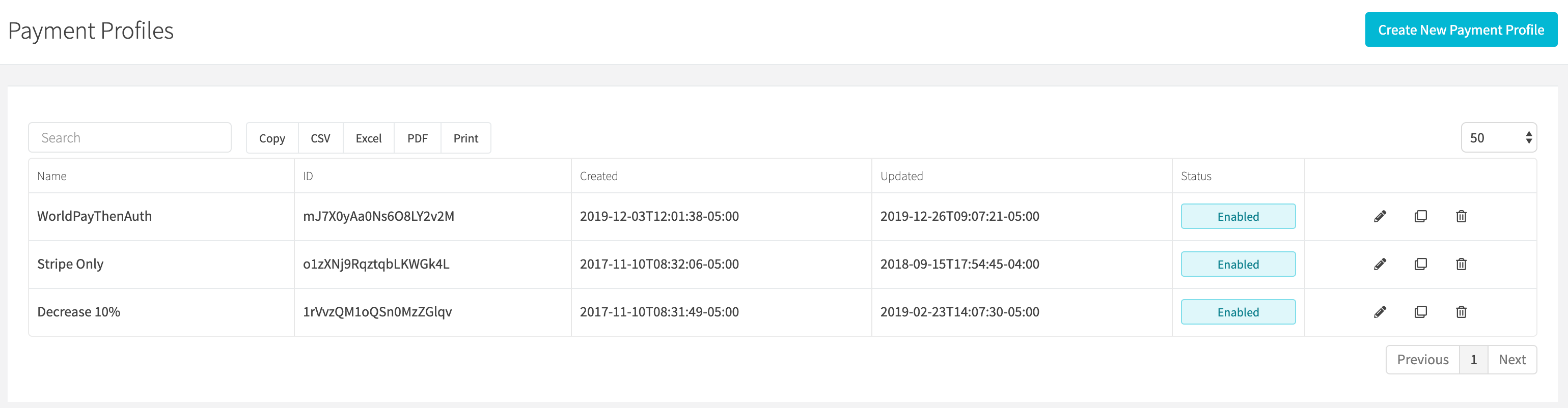
Create A BIN Profile
Create a new BIN profile by clicking the Create New BIN Profile button when viewing all BIN profiles or go to https://revcent.com/user/new-bin-profile
Basic Fields

Name
Enter a name for the payment profile. Required.
Description
Enter a description for the payment profile.
Status
Set the status of the payment profile.
Edit A BIN Profile
Edit an existing BIN profile by clicking the edit button when viewing all BIN profiles.
Details

Name
Enter a name for the BIN profile. Required.
Description
Enter a description for the BIN profile.
Status
Set the status of the BIN profile.
BIN Table
The BIN table is where you provide the list of BINs applicable to the profile. RevCent will use the values you submit in the table and generate all possible BIN 6 or BIN 8 numbers specific to the profile. Note: There is a 5000 BIN limit per profile.
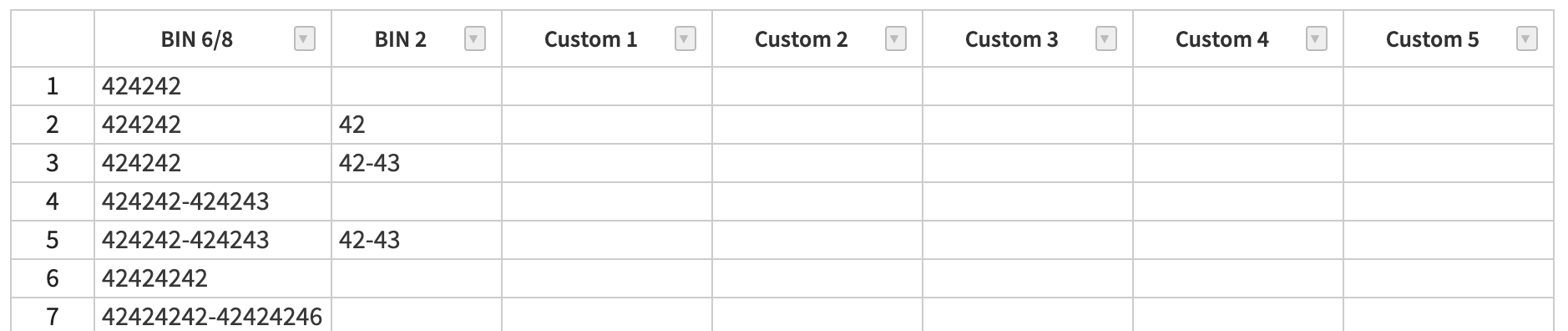
BIN 6/8
Enter an individual or ranged BIN 6 or BIN 8 value.
- Entries must be exactly six or eight digits.
- Ranged values must be in the form of LOWEST-HIGHEST.
- Range difference cannot exceed 5000.
BIN 2
If you entered an individual or ranged BIN 6 in the first column, you can provide an additional two digits, either as an individual number or range. If BIN 2 is present, the BIN 6 is converted into a BIN 8, disposing the BIN 6 variant for that row.
- BIN 2 entries must be exactly two digits.
- You cannot enter a BIN 8 in the first column and include a value in BIN 2, as this would generate a 10 digit BIN.
Custom X
Use the custom columns to include additional information for each bin row.
BIN Examples
The table below shows the BINs generated based on the individual or ranged entries for BIN 6/8 and BIN 2. Invalid entries will result in an error.
| BIN 6/8 | BIN 2 | Generated BIN(s) | Explained |
|---|---|---|---|
| 424242 | 424242 | Individual BIN 6. | |
| 424242 | 42 | 42424242 |
BIN 6 + BIN 2 results in individual BIN 8. The BIN 6 value is not saved. |
| 424242 | 42-43 |
42424242 42424243 |
BIN 6 + BIN 2 range generates two unique BIN 8 values. The BIN 6 value is not saved. |
| 424242-424243 |
424242 424243 |
BIN 6 range generates two unique BIN 6 values. | |
| 424242-424243 | 42-43 |
42424242 42424243 42424342 42424343 |
BIN 6 range + BIN 2 range generates four unique BIN 8 values. The BIN 6 ranged values are not saved. |
| 42424242 | 42424242 | Individual BIN 8. | |
| 42424242-42424244 |
42424242 42424243 42424244 |
BIN 8 range generates three unique BIN 8 values. | |
| 4242 | INVALID | Column BIN 6/8 must be exactly six or eight digits. | |
| 424242 | 424 | INVALID | Column BIN 2 must be exactly two digits. |
| 42424242 | 42 | INVALID | Results in 10 Digit BIN. |
| 42000000-44000000 | INVALID | Range difference cannot exceed 5000. |